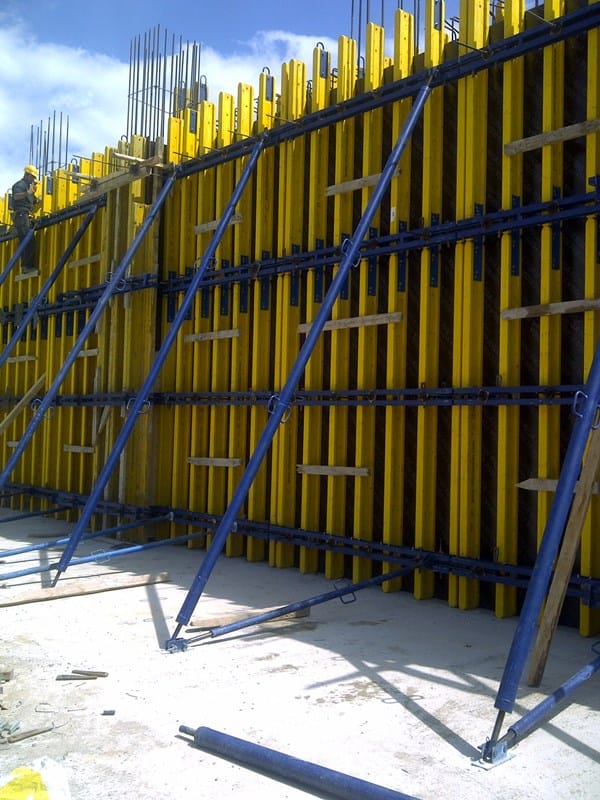
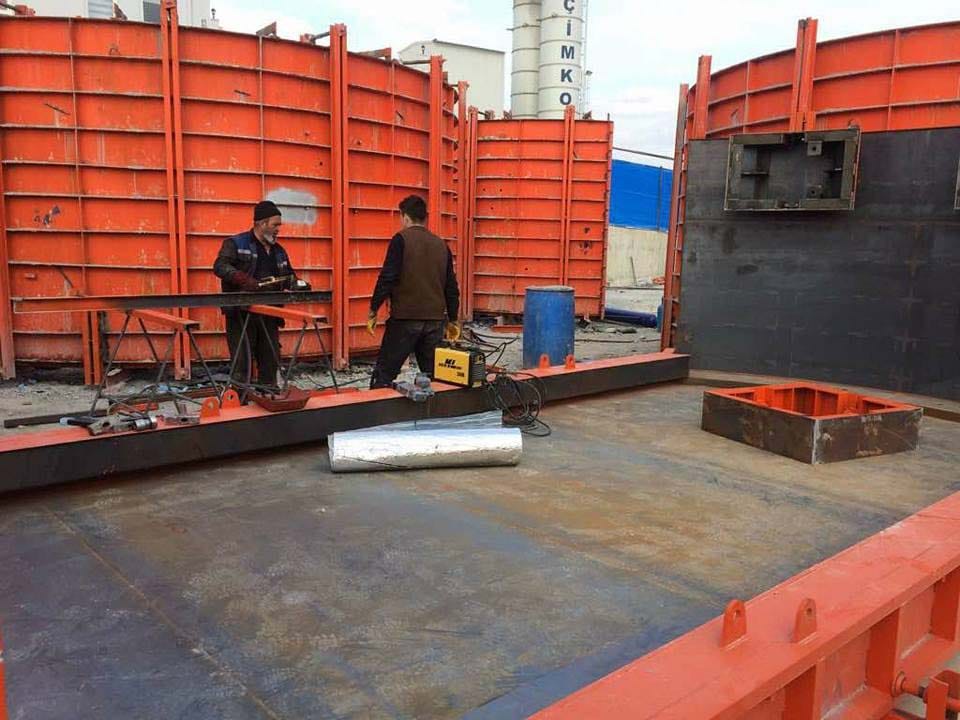
Circular structures — water tanks, silos, treatment basins — are structurally efficient: they resist internal pressure in tension and develop no corner stresses. But that efficiency depends on achieving the geometry correctly, and there the formwork is decisive.
Fixed or adjustable radius?
If many pours will be made at a single diameter, fixed-curvature segments are both more rigid and more economical. Systems used at several diameters need an adjustable connection detail, and that flexibility increases segment count and cost.
One question is usually enough: how many different diameters do you plan to use this formwork at over the coming years? If the answer is one, choose fixed radius; if more than one, adjustable.
Climbing arrangement
Tall tanks are not cast in a single lift. The formwork works in a climbing arrangement: one level is cast, and once the concrete has set the formwork is raised to the next level and anchored to the previous pour.
- Each level must have a working platform and safety guardrail
- Anchor points are planned according to the strength of the level below
- The lift height is set by pour rate and curing time
- Plumb must be checked at every level so deviation does not accumulate
Watertightness in water structures
In structures in contact with water, formwork affects not only geometry but watertightness. The critical points are:
- Tie rod holes: Every tie that penetrates the wall is a potential leakage path. Sealed systems or lost-tie components should be used.
- Construction joints: The waterstop recess must be defined in the formwork.
- Surface quality: A porous, flashed internal surface weakens watertightness. Watertight mould joints and correct vibration are essential.
- Release agent: Suitability must be verified for potable water structures.
What is different about silos?
In silos the internal pressure depends on the stored material and its discharge behaviour, producing a different loading regime from water structures. Wear also makes internal surface durability important. The formwork requirement, however, is the same: correct geometry and a smooth surface.
In summary
Formwork selection for circular structures is driven by diameter, height, frequency of use and contact with water. Share these four parameters for your project and we can determine the right system together.